Payment by PayID or bank transfer.
A Certificate of Analysis is not currently linked for this product.
Published research is separate from the batch test results for this vial.
Browse the research librarySynthetic octapeptide for topical research only. Modelled on SNAP-25, investigated in cosmetic-chemistry research at 0.005% active concentration on skin.
Listed Purity
99.50%
Method
HPLC
Certificate
Not published$8.00 / mg
In stock, ships from Sydney
For research use only. Not for human consumption. By purchasing this product, you confirm it will be used solely for legitimate research purposes.
Synthetic octapeptide for topical research only. Modelled on SNAP-25, investigated in cosmetic-chemistry research at 0.005% active concentration on skin.
SNAP-8 is a topical research peptide. Published research has studied it in cosmetic-chemistry formulations applied to the skin, not as an injectable. All research protocols described below refer to topical application in a laboratory setting.
SNAP-8 is a synthetic eight-amino-acid peptide developed by Lipotec (Barcelona, now part of Lubrizol) and introduced in the mid-2000s as a second-generation extension of Argireline (acetyl hexapeptide-8). Under the INCI system it is registered as Acetyl Octapeptide-3, and in some peptide chemistry references it is listed as Acetyl Glutamyl Heptapeptide-1. Its CAS number is 868844-74-0.
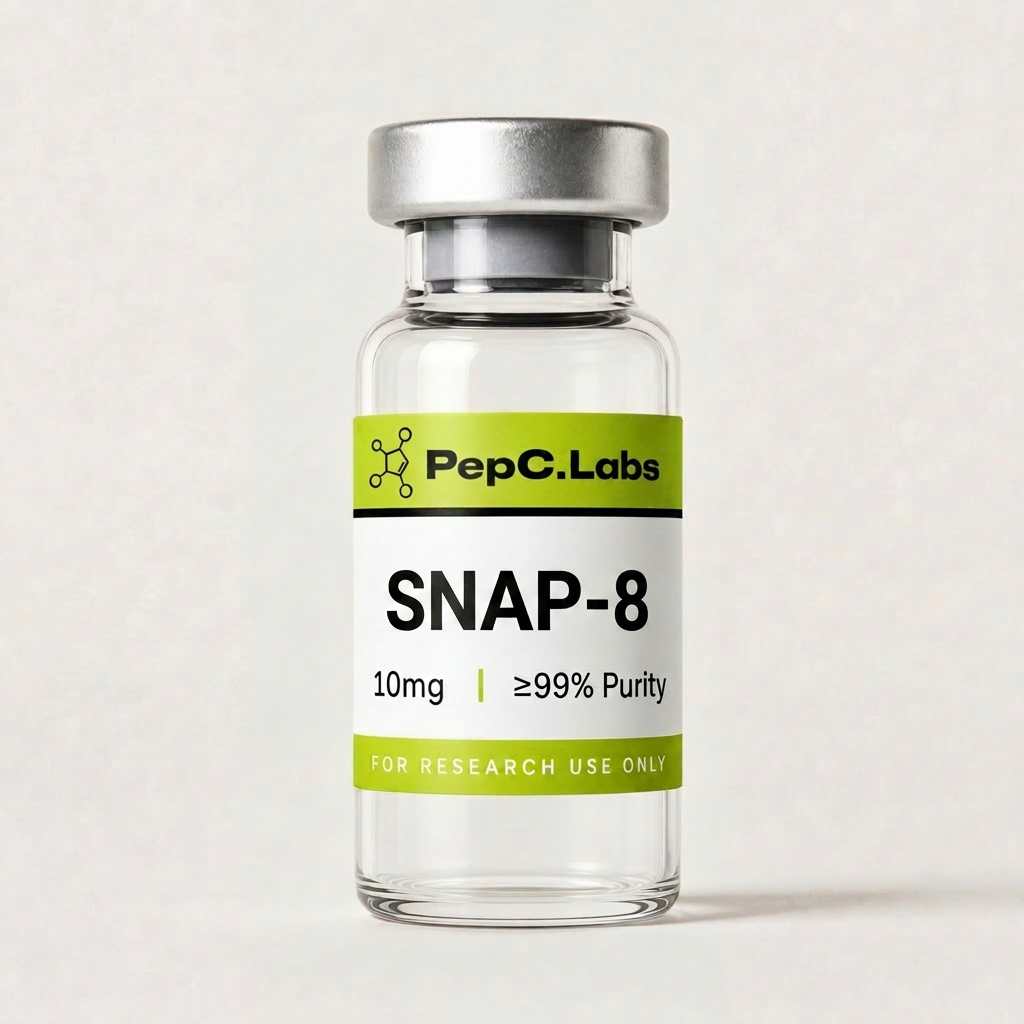
This vial contains 10mg of SNAP-8 as a lyophilised powder for reconstitution with sterile diluent in the laboratory.
SNAP-8 is a linear, N-terminally acetylated, C-terminally amidated octapeptide with the sequence Ac-Glu-Glu-Met-Gln-Arg-Arg-Ala-Asp-NH2. It has a reported monoisotopic mass of approximately 1075 Da.
The sequence is a direct mimic of a fragment at the N-terminal end of SNAP-25, a synaptosomal-associated protein that sits at the core of the SNARE complex. SNAP-8 extends the six-residue Argireline sequence by two additional residues (alanine and aspartic acid), which is reported in the supplier literature to broaden the section of SNAP-25 that the peptide can mimic.
The published mechanistic description of SNAP-8 centres on the SNARE complex, the four-helix protein bundle (syntaxin, synaptobrevin and SNAP-25) that drives synaptic vesicle docking and neurotransmitter release at the presynaptic membrane.
SNAP-8 is described in the supplier and secondary literature as a competitive, non-covalent mimic of the N-terminal portion of SNAP-25. The proposed model is that the peptide occupies binding sites normally used by native SNAP-25, slowing or destabilising SNARE assembly and, in turn, modulating acetylcholine release at the neuromuscular junction.
This is explicitly distinct from the mechanism of botulinum toxin, which enzymatically cleaves SNAP-25. SNAP-8 does not cleave SNAP-25 and is described as a reversible interaction in the available literature.
The molecular detail remains supplier-led. There is no large published peer-reviewed body of in vivo pharmacokinetic work on SNAP-8 comparable to that available for classical neuropeptides, and its skin-permeability profile is an active methodological question in the cosmetic-chemistry literature.
Published and supplier-sponsored research contexts for SNAP-8 include:
Published human clinical data on SNAP-8 remains limited in scope and is predominantly supplier-sponsored. There is no peer-reviewed data on systemic administration in humans.
Critical concentration clarification: the widely repeated "3% to 10%" figure in consumer cosmetic copy refers to the incorporation rate of a supplied aqueous peptide solution that itself contains only approximately 0.05% pure SNAP-8 by weight. The true pure-peptide concentration on skin in the Lipotec developer-sponsored study is approximately 0.005% w/w, not 3% or 10%. Researchers planning protocols should work from pure-peptide weight, not supplier-solution incorporation rate.
The most widely cited developer-sponsored study applied a supplier solution at 10% incorporation in a finished formulation. That supplier solution contained approximately 0.05% pure peptide, resulting in an on-skin pure-peptide concentration of approximately 0.005%. The ingredient-supplier technical range (3% to 10% incorporation of supplier solution) corresponds to approximately 0.0015% to 0.005% pure peptide on skin.
The developer-sponsored protocol applied the formulation twice daily for 28 days on a small panel, with wrinkle-depth imaging as the primary endpoint. Longer 56-day or 84-day windows referenced in downstream cosmetic marketing are not consistently documented in the original developer dossier and should be treated as unverified.
To mirror the developer-sponsored stock solution (approximately 0.05% pure peptide), reconstitute 10mg of powder in 20mL of carrier. Applying that stock at the published 10% incorporation rate in a finished topical formulation yields approximately 0.005% pure peptide on skin. Applying at the 3% lower bound yields approximately 0.0015%.
Published research uses SNAP-8 in simple aqueous carrier (water with a preservative such as caprylyl glycol), incorporated into finished emulsions, hydrogels, or serums at the cool-down phase below 40°C to preserve peptide integrity.
No peer-reviewed research supports systemic (injected) administration of SNAP-8. This product is supplied for topical research formulation and laboratory analytical research only.
A laboratory report is not currently published for this listing. Contact support about documentation for the size and batch you need before ordering. The vial is shipped lyophilised to preserve stability during transit and should be stored at or below -20°C prior to reconstitution and at 2-8°C after reconstitution in the laboratory.
For background on handling lyophilised research peptides, see our reconstitution calculator.
For research use only. Not for human consumption. The information provided is for educational and research purposes only. This product is not intended to diagnose, treat, cure, or prevent any disease. Always consult published peer-reviewed literature before designing research protocols.