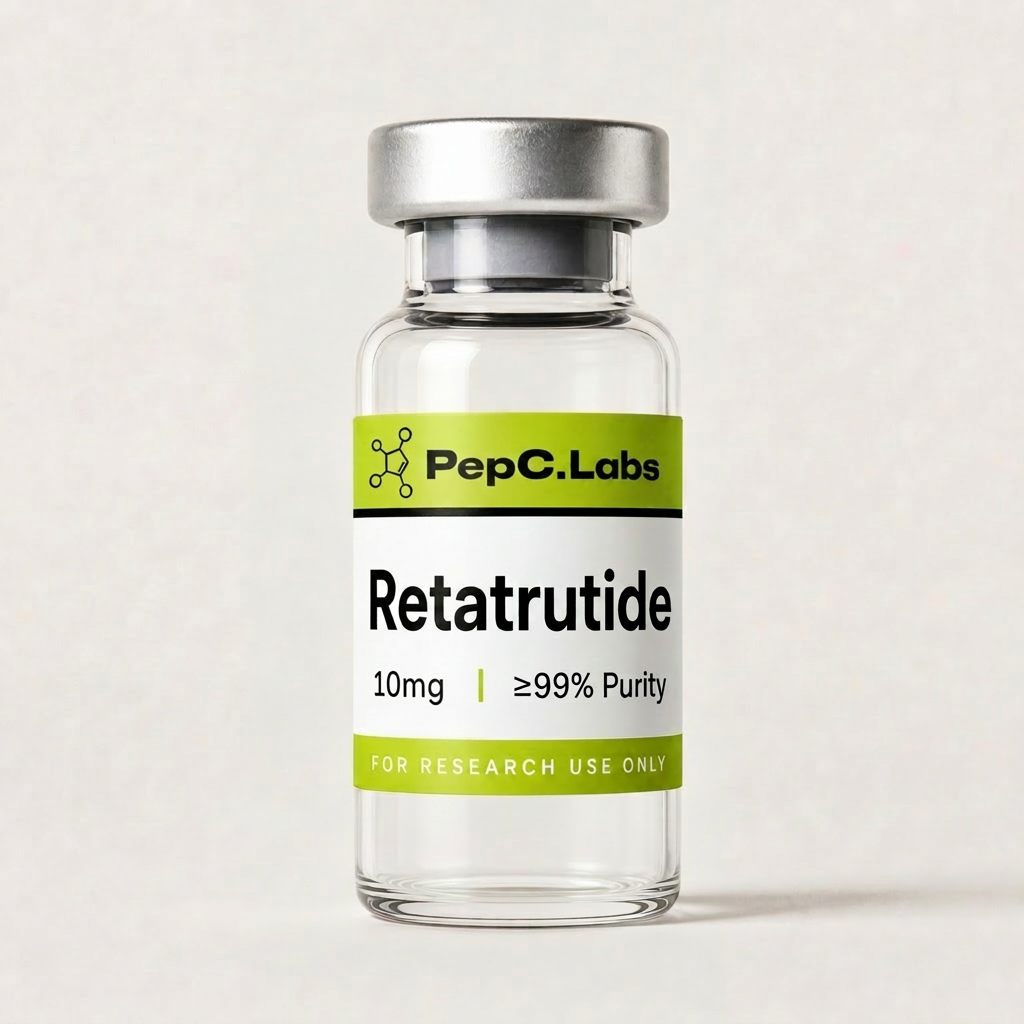
A novel triple agonist peptide targeting GIP, GLP-1, and glucagon receptors.
Overview
Retatrutide is a novel triple agonist research peptide currently in the published clinical literature. It is designed to simultaneously engage three different receptors: the glucose-dependent insulinotropic polypeptide (GIP) receptor, the glucagon-like peptide-1 (GLP-1) receptor, and the glucagon receptor. This triple mechanism distinguishes it from earlier single-agonist and dual-agonist compounds in the incretin research category.
This vial contains 10mg of Retatrutide as a lyophilised powder for reconstitution with sterile diluent in the laboratory.
Background on Triple Agonist Research
Retatrutide sits at the current frontier of metabolic research peptides. Earlier compounds in this research lineage include single-agonist GLP-1 analogues such as liraglutide and semaglutide, both widely studied in the published literature, and dual-agonist GIP/GLP-1 compounds such as tirzepatide. Retatrutide extends this research by adding glucagon receptor activation to the profile.
Scientists are investigating how simultaneous activation of GIP, GLP-1, and glucagon receptors affects:
Energy expenditure modulation in animal models
Hepatic glucose regulation pathways
Gastric emptying and satiety signal research
Lipid metabolism in preclinical models
Insulin sensitivity markers in rodents
Published Research
Preclinical studies on Retatrutide have been conducted primarily in rodent and non-human primate models. More recently, Phase 2 clinical trial data has been published in peer-reviewed journals, reporting observations on metabolic markers and energy balance pathway activity. These trials are research studies conducted under regulatory approval and supervision. Retatrutide is not currently approved by the TGA or any other regulatory body for therapeutic use.
Published research has explored Retatrutide in the context of:
Insulin sensitivity research in models of metabolic dysfunction
Hepatic steatosis research models
Glycemic control studies in preclinical protocols
Cardiovascular marker response in animal models
Mechanism of Action
The triple agonist design aims to exploit the complementary roles of each target receptor. GLP-1 agonism is associated in published research with effects on satiety signalling and pancreatic beta cell response. GIP agonism has been studied for its role in insulin secretion and adipocyte biology. Glucagon receptor agonism is researched for its effects on hepatic energy metabolism and lipolysis.
Researchers hypothesise that simultaneously targeting all three pathways may produce effects that differ from those observed with single or dual agonists. The published preclinical literature suggests additive effects on markers of metabolic regulation, though the underlying mechanisms remain an active area of investigation.
Quality and Verification
A published laboratory report is linked on this product page. Check its sample description, methods and batch information, and contact support to confirm documentation for the size and batch you need. The vial is shipped lyophilised to preserve stability during transit and should be stored at -20°C prior to reconstitution and 2-8°C after reconstitution in the laboratory.
Further Reading
For background on reconstitution of lyophilised research peptides, see our
reconstitution calculator.
Disclaimer
For research use only. Not for human consumption. The information provided is for educational and research purposes only. This product is not intended to diagnose, treat, cure, or prevent any disease. Always consult published peer-reviewed literature before designing research protocols.