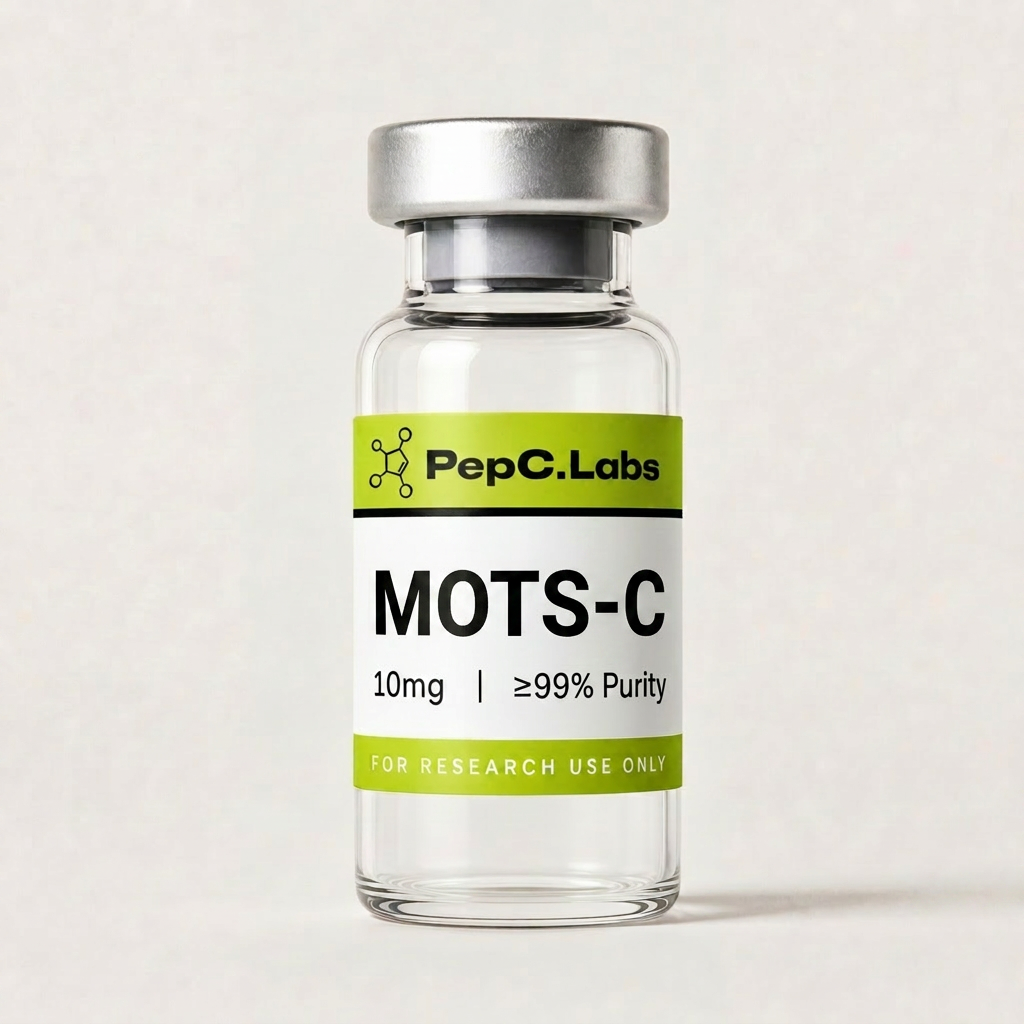
A mitochondria-derived peptide investigated for its role in metabolic regulation and exercise mimetic properties.
Overview
MOTS-c is a mitochondria-derived peptide encoded in the mitochondrial 12S ribosomal RNA gene. It is one of the first members of a newly discovered class of mitochondrial-derived peptides and has been investigated in published research for its role in metabolic regulation and exercise mimetic pathway research in animal models.
This vial contains 10mg of MOTS-c as a lyophilised powder for reconstitution with sterile diluent in the laboratory.
What is MOTS-c?
MOTS-c stands for "mitochondrial open reading frame from the 12S rRNA type c." It is a 16-amino-acid peptide that was identified in 2015 as being encoded within the mitochondrial genome rather than the nuclear genome. This makes it a member of an emerging class of peptides that challenge the traditional view that mitochondria produce only proteins involved in oxidative phosphorylation.
Published research in animal models has explored MOTS-c in the context of:
Metabolic regulation and insulin sensitivity research
AMPK pathway activation studies
Exercise mimetic pathway research
Skeletal muscle energy metabolism models
Folate metabolism research
Mechanism of Action
Preclinical studies suggest MOTS-c activates the AMP-activated protein kinase (AMPK) pathway, a central regulator of cellular energy metabolism. Researchers have investigated how MOTS-c administration in rodent models influences markers of insulin sensitivity and glucose uptake in skeletal muscle tissue. Some published research has framed MOTS-c as an "exercise mimetic" because of observed pathway overlap with exercise-induced metabolic adaptations in animal models.
The precise molecular mechanisms and downstream effects remain an active area of investigation in the published literature.
Published Research
Published research on MOTS-c has been conducted primarily in rodent models and cell culture. Areas of investigation have included:
Insulin sensitivity markers in rodent models of metabolic dysfunction
AMPK pathway activation in skeletal muscle
Glucose uptake research in cell culture
Mitochondrial function studies
Folate metabolism pathway research
Clinical data in humans is very limited, and MOTS-c is not approved by the TGA for any therapeutic indication.
Quality and Verification
A published laboratory report is linked on this product page. Check its sample description, methods and batch information, and contact support to confirm documentation for the size and batch you need. The vial is shipped lyophilised to preserve stability during transit and should be stored at -20°C prior to reconstitution and 2-8°C after reconstitution in the laboratory.
Further Reading
For background on handling lyophilised research peptides, see our
reconstitution calculator.
Disclaimer
For research use only. Not for human consumption. The information provided is for educational and research purposes only. This product is not intended to diagnose, treat, cure, or prevent any disease. Always consult published peer-reviewed literature before designing research protocols.