Modified Growth Hormone Releasing Hormone analogue for pulsatile release research.
Overview
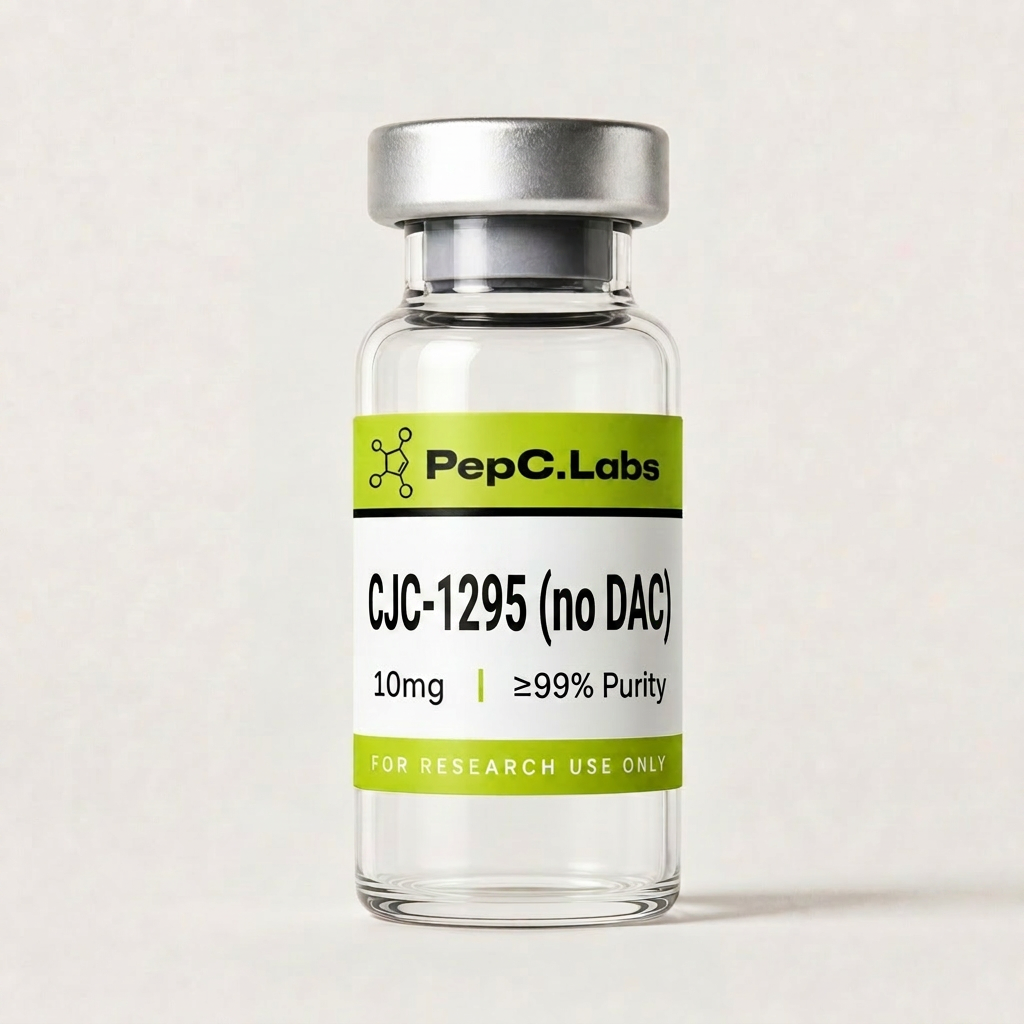
CJC-1295 (no DAC) is a synthetic analogue of Growth Hormone Releasing Hormone. The "no DAC" designation refers to the absence of a Drug Affinity Complex, a modification that would otherwise extend the peptide's half-life by binding to serum albumin. Without the DAC modification, CJC-1295 has a significantly shorter half-life, which makes it of interest in research protocols studying pulsatile growth hormone release.
This vial contains 10mg of CJC-1295 (no DAC) as a lyophilised powder for reconstitution with sterile diluent in the laboratory.
What is CJC-1295?
CJC-1295 is a modified version of GHRH (1-29), the bioactive fragment of endogenous Growth Hormone Releasing Hormone. The four amino acid substitutions in CJC-1295 protect the peptide from enzymatic degradation by dipeptidyl peptidase-4 (DPP-4), extending its biological half-life relative to native GHRH.
Published research has investigated CJC-1295 (no DAC) in the context of:
Pulsatile GH release pathway research
GHRH receptor binding studies
Growth hormone axis research in animal models
IGF-1 pathway research
Protein synthesis marker research in rodent models
CJC-1295 (no DAC) vs CJC-1295 DAC
The two forms of CJC-1295 are used for different research purposes. The DAC-modified form has an extended half-life of up to several days due to its binding to serum albumin, producing sustained GH elevation in preclinical models. The no-DAC form has a half-life of approximately 30 minutes, which more closely mimics the natural pulsatile release pattern of GH in rodent research models.
Researchers studying pulsatile GH dynamics typically prefer the no-DAC form, while those studying sustained receptor activation may prefer the DAC variant.
Published Research
Published preclinical research on CJC-1295 has explored GHRH receptor pharmacology, GH pulse frequency modulation, and IGF-1 response in animal models. Human clinical data is limited, and CJC-1295 is not approved by the TGA for any therapeutic indication.
Quality and Verification
A published laboratory report is linked on this product page. Check its sample description, methods and batch information, and contact support to confirm documentation for the size and batch you need. The vial is shipped lyophilised to preserve stability during transit and should be stored at -20°C prior to reconstitution and 2-8°C after reconstitution in the laboratory.
Further Reading
For background on handling lyophilised research peptides, see our
reconstitution calculator.
Disclaimer
For research use only. Not for human consumption. The information provided is for educational and research purposes only. This product is not intended to diagnose, treat, cure, or prevent any disease. Always consult published peer-reviewed literature before designing research protocols.