Why Purity Matters: What 99%+ Really Means for Research Peptides
31 March 2026 · PepC.Labs
For research use only
This article is research education for laboratory and research-use audiences. Products mentioned are sold strictly for in-vitro research and not for human or veterinary consumption.
If you've spent any time sourcing research peptides, you've seen the number everywhere: 99% purity. But what does that actually mean, and why should it matter to your work?
Purity Isn't a Marketing Claim. It's a Measurable Standard.
Peptide purity refers to the percentage of the target peptide present in a given sample, as measured by High-Performance Liquid Chromatography (HPLC). A purity of 99.1% means that 99.1% of the sample is the intended peptide sequence, with the remaining fraction consisting of truncated sequences, deletion variants, or synthesis by-products.
This matters because impurities introduce variables. If you're running dose-response assays or comparing results across batches, even small inconsistencies in peptide composition can skew data and compromise reproducibility.
How Purity Is Measured
The gold standard is reverse-phase HPLC, which separates peptide components by hydrophobicity. The resulting chromatogram shows peaks corresponding to each component. The target peptide should dominate with a single, clean peak.
Mass spectrometry (MS) is used alongside HPLC to confirm molecular identity. While HPLC tells you how pure the sample is, MS confirms that the dominant compound is actually the correct peptide.
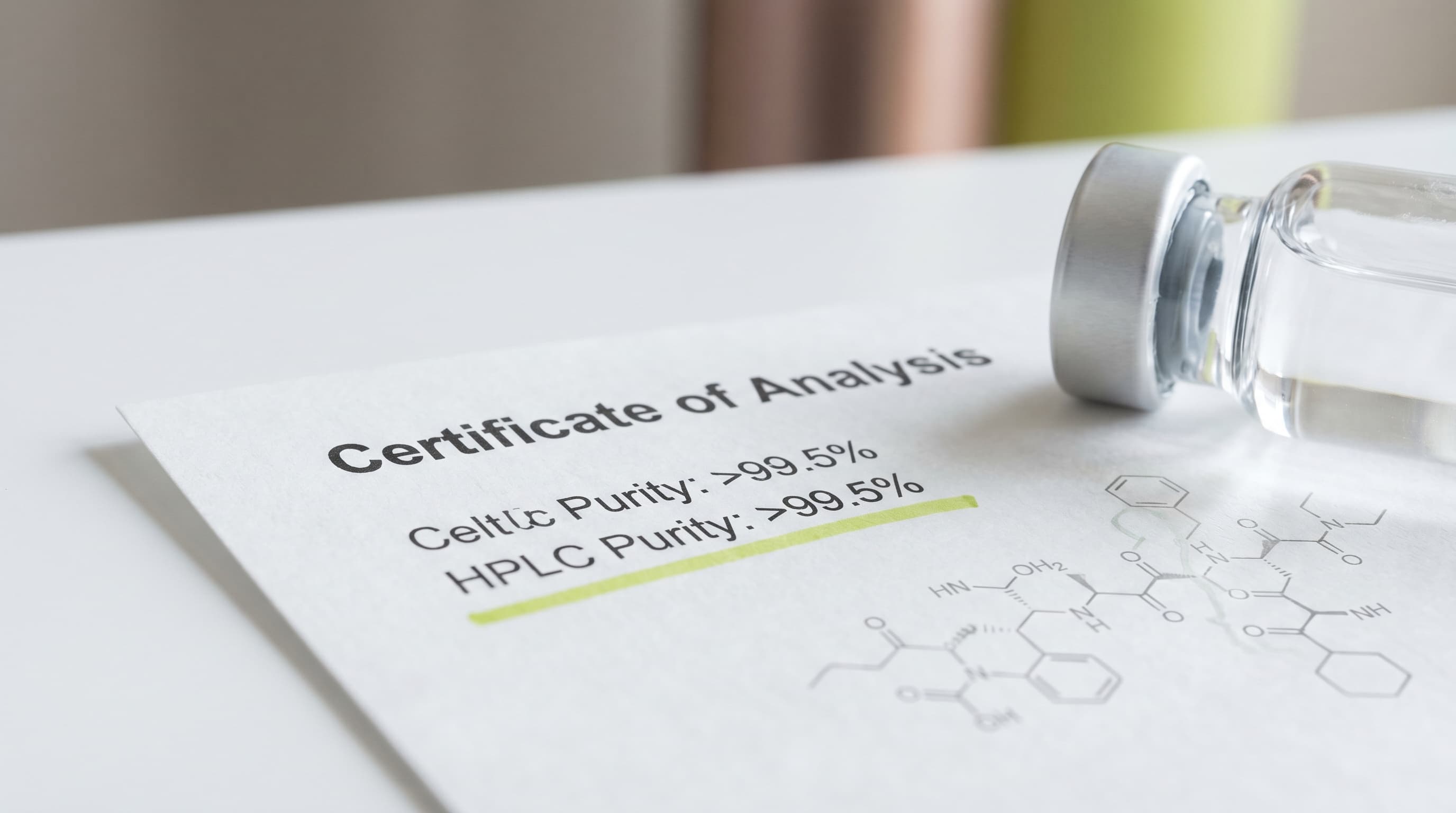
At PepC.Labs, every batch undergoes both HPLC and MS verification before release. The results are documented in a Certificate of Analysis (COA) available for each product.
How to Read a Certificate of Analysis
A COA should include at minimum:
If a supplier can't provide a COA, or if their COA lacks batch-specific data, that's a red flag. Generic or templated certificates that don't reference a specific lot mean the testing may not have been performed on the product you're receiving.
Why We Test Every Batch
Some suppliers test a representative batch and apply the results across subsequent production runs. We don't do that. Every batch we release is independently tested, because synthesis conditions can vary between runs. A peptide that tested at 99.3% last month may not hit the same mark this month without verification.
This is what "research grade, no compromise" means in practice. It's not a tagline. It's a quality control protocol.
The Bottom Line
When evaluating a peptide supplier, purity claims only matter if they're backed by verifiable, batch-specific testing. Look for HPLC and MS data, confirm the COA is lot-specific, and don't settle for vague assurances.
Every product at PepC.Labs ships with verified >=99% purity and a batch-specific COA, because your research deserves data you can trust.
The information in this article is for educational and research purposes only. Products mentioned are intended for laboratory and research use only and are not intended for human consumption. Always consult relevant regulations in your jurisdiction.