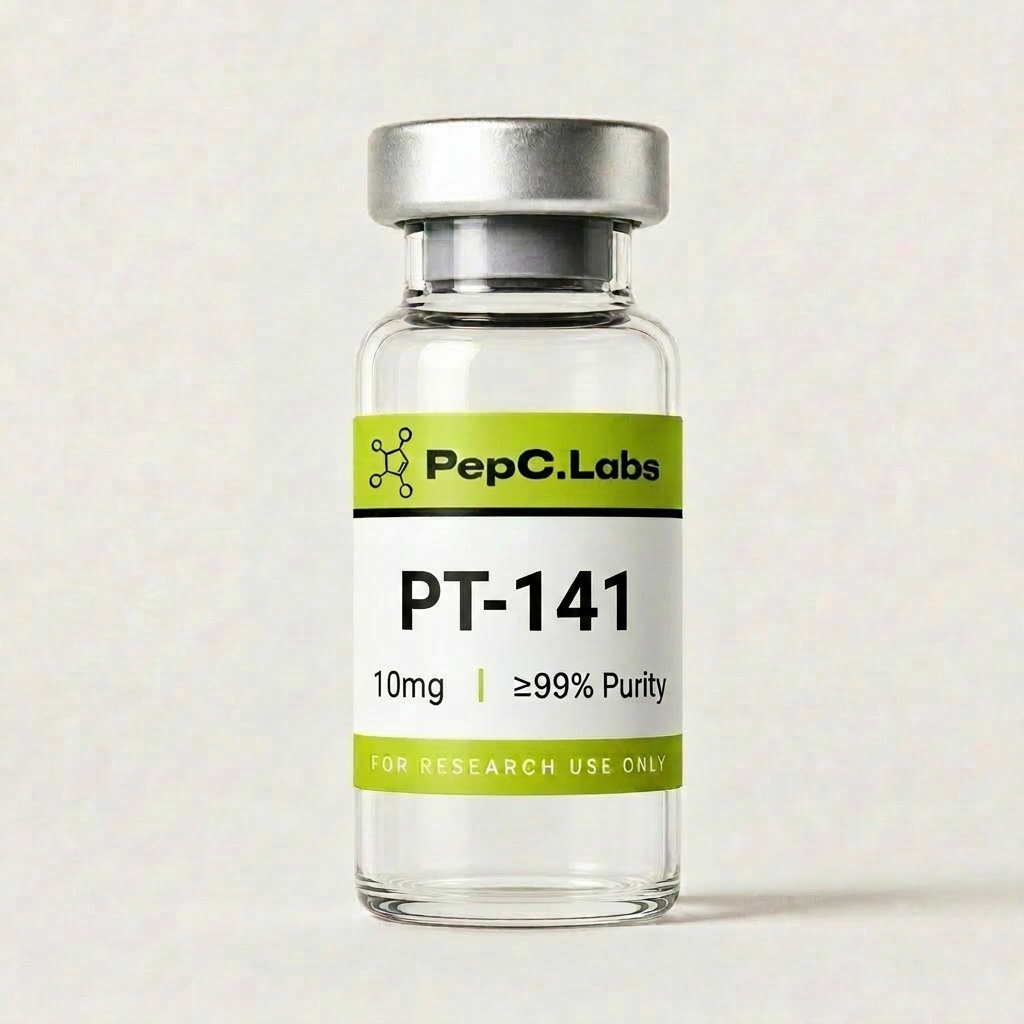
Know what’s in your vial.
- Labelled contents
- 10mg
- Listed purity
- 99.00%
A Certificate of Analysis is not currently linked for this product.
Published research
Published research is separate from the batch test results for this vial.
Browse the research libraryPT-141 10mgResearch Peptide
Bremelanotide. A melanocortin-receptor agonist research peptide. Studied in central nervous system melanocortin signalling research.
Listed Purity
99.00%
Method
HPLC
Certificate
Not published$9.00 / mg
In stock, ships from Sydney
For research use only. Not for human consumption. By purchasing this product, you confirm it will be used solely for legitimate research purposes.
Bremelanotide. A melanocortin-receptor agonist research peptide. Studied in central nervous system melanocortin signalling research.
Overview
PT-141 (Bremelanotide) is a synthetic cyclic heptapeptide research compound that acts as a non-selective agonist at melanocortin receptors, with particular activity at the melanocortin-4 receptor (MC4R) in the central nervous system. It is a structural analogue of alpha-melanocyte-stimulating hormone (alpha-MSH).
This vial contains 10mg of PT-141 as a lyophilised powder for reconstitution with sterile diluent in the laboratory.
What is PT-141?
PT-141 is a research peptide closely related to Melanotan-II. Where Melanotan-II preserved the full melanocortin receptor activation profile (including MC1R, the receptor responsible for pigmentation), PT-141 is the carboxyl-terminal des-amide variant. The structural change shifts activity away from the peripheral pigmentation pathways and toward central nervous system melanocortin signalling, principally MC3R and MC4R in hypothalamic nuclei.
Published research has investigated PT-141 in the context of:
Background on Melanocortin Research
The melanocortin system comprises five G-protein-coupled receptors (MC1R through MC5R) and their endogenous ligands derived from proopiomelanocortin (POMC). MC4R is densely expressed in hypothalamic nuclei and has been studied for its role in energy homeostasis, autonomic outflow and behavioural research endpoints. Mutations in MC4R are the most common monogenic cause of severe obesity in published human cohorts, which has made the receptor a long-standing target of metabolic research.
PT-141 was originally developed as a research probe at the boundary of central melanocortin pharmacology and downstream physiological signalling. Clinical research has been published in peer-reviewed journals investigating central melanocortin pathway activity.
Published Research
Preclinical research on PT-141 has been conducted in rodent and non-human primate models. Published clinical research has appeared in peer-reviewed journals. Areas of published investigation include:
PT-141 is supplied strictly as a research reagent for laboratory research purposes.
Quality and Verification
A laboratory report is not currently published for this listing. Contact support about documentation for the size and batch you need before ordering. The vial is shipped lyophilised to preserve stability during transit and should be stored at -20°C prior to reconstitution and 2-8°C after reconstitution in the laboratory.
Further Reading
For background on handling lyophilised research peptides, see our reconstitution calculator. See also our long-form description of Melanotan-II for context on the broader melanocortin agonist research family.
Disclaimer
For research use only. Not for human consumption. The information provided is for educational and research purposes only. This product is not intended to diagnose, treat, cure, or prevent any disease. Always consult published peer-reviewed literature before designing research protocols.